
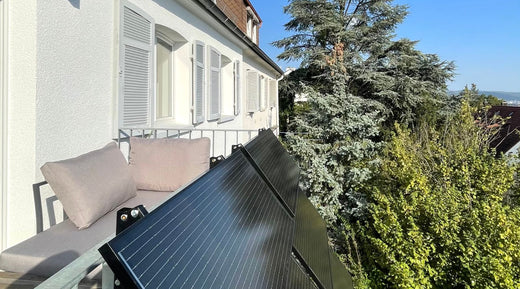
To use solar panels effectively, you need to make the most of every ray of sunshine. The key factors for efficient balcony solar power are an unobstructed view and an optimal tilt angle. It's important to carefully check the location for shading and adjust the tilt angle according to the season and orientation to ensure maximum energy production.
Balcony power plant orientation - The most important points in brief
- Optimal orientation: A south-facing orientation provides the best energy yields. Alternatives such as east and west orientations can be advantageous depending on electricity consumption patterns.
- Tilt angle: In summer, shallower angles (20–30 degrees) are ideal, in winter steeper angles (40–50 degrees).
- Location selection: An unshaded location such as a balcony, terrace or roof is crucial for maximum yields.
- Maintenance: Regular cleaning and inspection of the fixings ensure long-term efficiency.
- Environmental protection: Balcony power plants reduce CO₂ emissions and support the energy transition.
Brief explanation of balcony power plants
Balcony power plants are small photovoltaic systems that can be installed on balconies, terraces, or in gardens. These mini solar systems can be connected directly to your home's electrical grid, allowing you to use the generated electricity immediately. Balcony power plants offer an excellent way to generate electricity sustainably while saving money. They are particularly attractive for renters and homeowners with limited space, as they can be installed flexibly and in a space-saving manner. With a balcony power plant, you can not only reduce your energy costs but also make an important contribution to environmental protection.
The orientation and tilt of a balcony solar power system are crucial factors for its efficiency and yield. Optimal orientation and tilt not only maximize electricity generation but also help reduce energy costs and contribute to environmental protection. Mini solar and mini PV systems are becoming increasingly popular, as they offer an attractive solution, especially for renters and homeowners with limited space. This article explains which factors are crucial for the orientation of a balcony solar power system and how to achieve the best results.

What exactly is the role of the correct balcony power plant orientation?
The impact on performance
The performance of a balcony solar power system depends largely on the amount of solar energy the solar panels can absorb. Incorrect orientation can significantly reduce the yield, while optimal orientation and tilt fully utilize your system's potential. Correct orientation is particularly crucial for mini solar systems, as the smaller panel area must be used efficiently. Solar panels should be positioned to capture the maximum amount of sunlight throughout the day.
Sunlight throughout the day
The sun's position changes throughout the day. Almost everyone is familiar with the saying, "The sun rises in the east and sets in the west." To capture the sun's rays as effectively as possible, the modules should be oriented to receive maximum sunlight. A south-facing orientation is particularly ideal in Central Europe, as the sun is visible there for most of the day, allowing stationary modules to capture the maximum amount of sunlight.
Advantages of maximum solar radiation
A south-facing orientation maximizes the use of solar energy, especially around midday when the sun is high in the sky. This time offers the most intense sunlight, resulting in peak performance from the solar panels and thus the best possible yield. This optimal use of solar energy is particularly important for mini PV systems, as it allows for higher efficiency from smaller modules.
Increased yield through the right orientation
Studies show that a south-facing orientation can increase yields by up to 20% compared to east- or west-facing orientations. Over the lifetime of a system, this can translate into significant cost savings. Electricity costs can also be considerably reduced through optimal orientation. Therefore, anyone wanting to maximize the performance potential of their PV modules should opt for a south-facing orientation.

East-West orientation: There are alternatives for specific needs.
Differences between South, East and West for different needs
- South-facing: As mentioned earlier, a south-facing orientation allows for maximum use of solar energy throughout the day. A mini solar system particularly benefits from this orientation, as it achieves the highest electricity yield when energy consumption is spread throughout the day.
- East and west facing: These orientations are advantageous when energy demand is highest in the morning or evening. They deliver lower overall yields but can better cover specific consumption patterns.
- Southwest or southeast: These intermediate options can be a good compromise if structural limitations or other obstacles prevent a perfect south-facing orientation.
Advantages of the east-west orientation
An east-west orientation can be advantageous if energy is primarily needed in the mornings or evenings. It allows for a more even distribution of generated electricity throughout the day and reduces peak times when the electricity might not be immediately used. These options are particularly attractive for households that can adjust their electricity consumption.
When is an east or west orientation advisable?
These orientations are particularly suitable for households with high energy consumption outside of midday hours. They are also advisable if structural conditions or shading prevent a south-facing orientation. In cases where the choice is between east and west, the individual consumption time should play a decisive role.
Energy yield with alternative orientations
Although the overall yield is lower, an east- or west-facing orientation can be efficient when combined with storage systems or adjusted consumption habits. This is especially true in the summer months when the sun is in the sky for longer periods. Using high-efficiency PV modules can partially compensate for the difference.
The angle of inclination is also a crucial factor.

The tilt angle affects how efficiently solar panels can absorb sunlight. An incorrect angle can significantly reduce energy yield, as an angle that is too steep or too shallow does not capture the light optimally. Solar power plants often use precisely calculated angles to maximize energy production.
Adjusting the tilt angle to the season
In summer, a shallower angle of about 20–30 degrees is optimal, while in winter a steeper angle of 40–50 degrees is preferred to capture the low-angled sun. Mini solar thermal systems and mini photovoltaic systems particularly benefit from this adjustment, as they can utilize their limited surface area efficiently.

Recommended tilt angles if you don't want to adjust them: 30 to 40 degrees
For most locations in Central Europe, an angle of 30 to 40 degrees is considered optimal. This setting ensures consistent energy production throughout the year. Adjusting the angle is particularly crucial for east- or west-facing installations.
Optimal alignment and tilt combine
The combination of a south-facing orientation and the correct tilt angle maximizes yield and ensures consistent power production. Adjustable mounting brackets can help adapt the modules to different conditions.
MoeCell – The solution for maximum energy
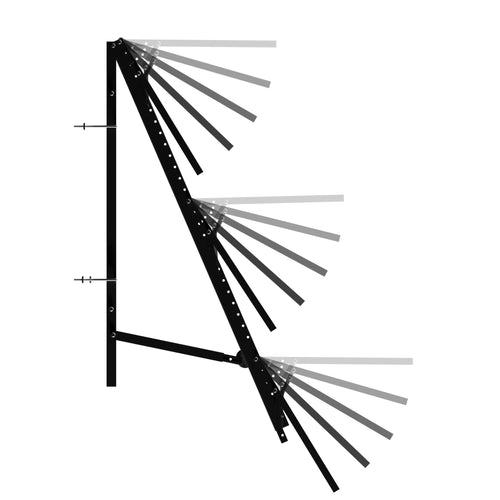
The The MoeCell system revolutionizes this with a unique dual-angle design. Both the system itself and the individual panels can be adjusted to achieve optimal tilt angles. This design allows the MoeCell to produce up to 50% more electricity than traditional, downward-facing panels. This is particularly effective on balconies where space and orientation options are limited.
Environmental benefits of optimal alignment
Reducing the CO₂ footprint
Efficient electricity generation using solar panels helps replace fossil fuels and reduce CO₂ emissions. With a balcony power plant, you can save a significant amount of CO₂ annually. Solar power thus becomes a sustainable energy source.
Sustainable electricity generation through your balcony power plant
A balcony power plant is an environmentally friendly way to generate your own electricity and become more independent from large energy suppliers. It's a step towards a sustainable energy future.
With a balcony power plant, you make a direct contribution to climate protection and promote the energy transition. Every kilowatt-hour of self-generated electricity reduces the need for fossil fuels, saves you money at home, and makes you a little more independent.
Location factors are important and should be considered to maximize potential.
Location selection: Making the right decision
An unshaded location is essential for maximum energy production. Balconies, terraces, or roofs are particularly suitable if they are exposed to sunlight all day. Mini PV systems offer a flexible solution here, as they can also be installed on smaller surfaces.
Shadow sources: Impact on performance
Even small shadows, for example from trees or buildings, can significantly reduce yield. Regularly checking the site helps to avoid such problems. Modern modules with bypass diodes can partially compensate for shading losses.
Geographical differences in orientation
Depending on latitude, slight adjustments to orientation and tilt angle may be necessary to efficiently utilize solar energy. For example, different tilt angles are optimal in southern Germany than in northern Germany.
Take weather and wind conditions into account
In windy areas, a stable mounting of the modules is crucial. Weather conditions such as snow and rain should also be considered during the planning phase. Special coatings can help to more easily shed snow and dirt.
Solar module sizes naturally have an impact on the yield.
The size of the solar panels plays a crucial role in the yield of your balcony power plant. The number and arrangement of the solar cells used determine both the efficiency and the physical size of the panels. Larger solar panels can capture more solar energy and thus achieve a higher yield. However, they also increase the cost of the system. Therefore, it is important to find the right balance between yield and cost.
At MOE, we offer various sizes and power levels. For example, our 185W system with mounting bracket and inverter , or the MoeCell Large Set (225W + mounting bracket) including inverter , and also the MoeCell Large Set (450W + mounting bracket) including inverter .
Attention: Of course, you can expand our sets with additional MoeCell Large systems. Depending on the power output, however, you will need a different inverter . You can find this further down the page.

Tips on installation, safety and efficiency
The right location for your balcony power plant
Choose a location that receives ample sunlight and is easily accessible. South-facing balconies are ideal, while east- or west-facing balconies may be well-suited to specific consumption patterns.
Module mounting: Safety and stability
High-quality brackets made of aluminum or stainless steel ensure secure and durable mounting of the solar panels. Additional reinforcements may be advisable in windy locations.

Checking the brackets and connections
After storms or strong winds, the mountings should be checked for stability. Loose connections can impair the system's performance.
Cable management and protection from the elements
Properly installed cables, protected from moisture and UV radiation, extend the system's lifespan. Avoid loose cables that could be damaged in strong winds.
Grounding and safety measures
Proper grounding protects the system from overvoltage and increases safety. This is particularly important to prevent electrical damage from lightning strikes.
How can the best efficiency be ensured in the long term?
Regular cleaning is important
Dust, dirt, and leaves can reduce the performance of the modules. Regular cleaning ensures that the modules maintain their maximum efficiency. Use water and a soft cloth to avoid scratches.
Software updates for monitoring systems
Modern balcony power plants often come equipped with monitoring software. Regular updates ensure optimal performance monitoring and provide early warnings of potential problems.
Ensuring efficiency: Technical inspections
Regular maintenance by qualified personnel ensures the longevity and efficiency of the system. This includes checking inverters, cables, and modules.
Frequently Asked Questions (FAQs)
Which orientation is best suited for balcony power plants?
A south-facing orientation is ideal in most cases, but does not offer the best solution for every location.
How much does the location influence the yield?
The location has a significant impact on performance. Shade or unfavorable orientations can considerably reduce the yield.
Can I adjust the modules when the sun is high in the sky?
Yes, adjustable module supports allow the tilt angle to be adjusted to the respective season.
What to do if alignment options are limited?
In such cases, east- or west-facing orientations in combination with a storage system can be advantageous. The use of modules with bypass diodes also helps to minimize power losses.



Leave a comment
This site is protected by hCaptcha and the hCaptcha Privacy Policy and Terms of Service apply.