

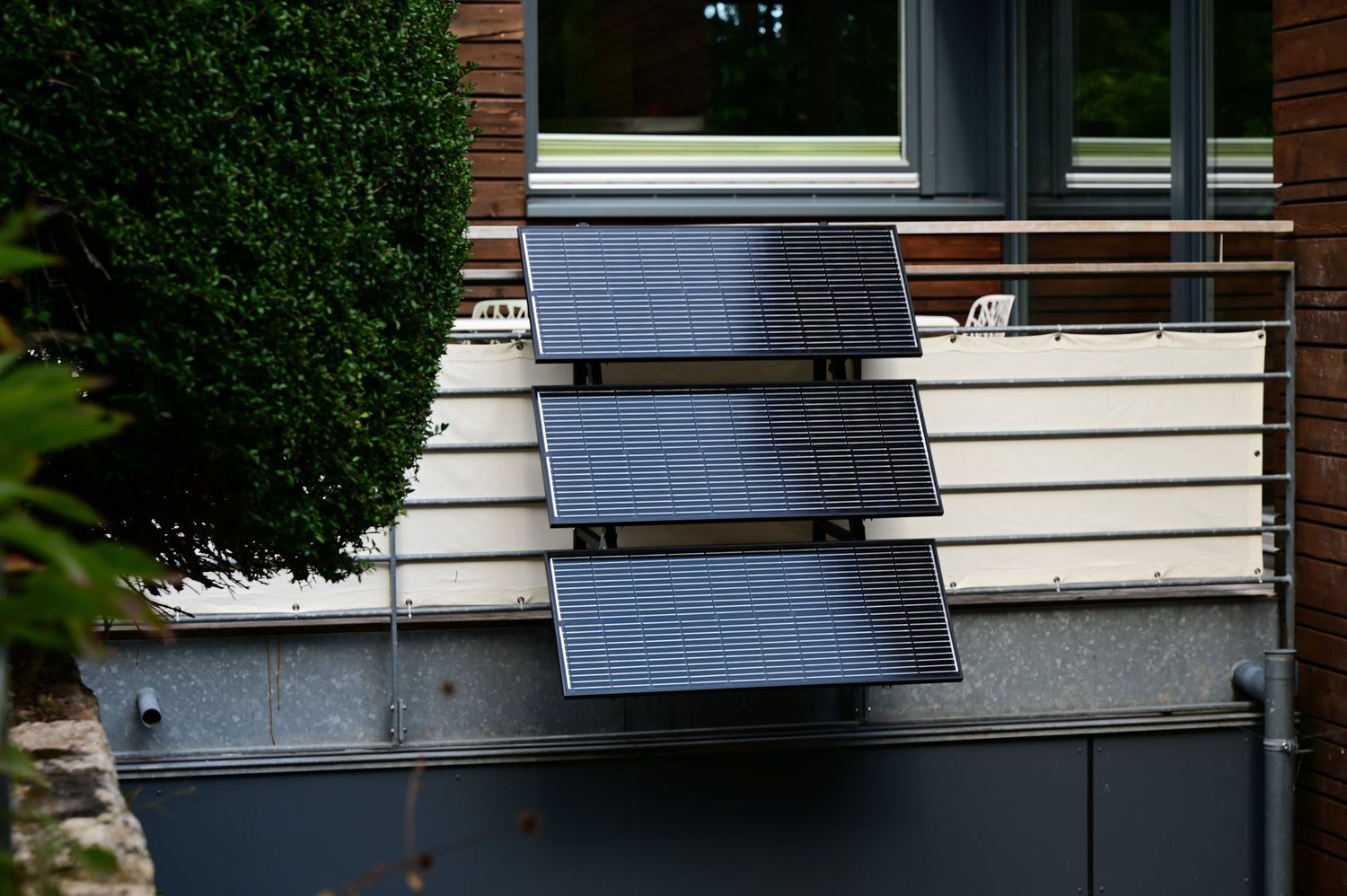
A balcony power plant, also known as a plug-in solar system or mini-PV system, is a compact photovoltaic system that can be installed on a balcony and plugged directly into a standard electrical outlet. These systems are particularly popular with renters and homeowners because they are easy to install and can be operated without significant construction work. Today, we'll take a closer look at the feed-in tariff for balcony power plants and explain what it entails.
The most important points in brief
While feed-in tariffs for balcony power plants don't offer high returns, they can be a worthwhile supplement to self-consumption. The greatest financial advantage lies in using the generated solar power yourself, as the savings on electricity costs are significantly higher than the income from the tariff. Anyone wishing to feed their electricity into the public grid should check the legal and technical requirements, including registration with the grid operator and in the market master data register . But let's start from the beginning.
What is a balcony power plant?
A balcony power plant, also known as a plug-in solar device or mini-photovoltaic system, is a compact photovoltaic system that plugs directly into a wall socket. These compact solar systems can be installed on balconies and other surfaces. They are particularly popular with renters and homeowners because they are easy to install and can be operated without significant construction work. Today, we'll take a closer look at the feed-in tariff for balcony power plants and explain what it entails.

Advantages of balcony power plants:
- Reducing electricity costs through self-consumption
- Environmentally friendly: Contribution to the use of renewable energies
- Flexible use for households with limited space
Balcony power plants differ from large photovoltaic systems in their output (usually up to 800 watts) and their focus on self-consumption rather than feeding electricity into the grid. They utilize solar energy efficiently by using the generated solar power directly in the household.
Technology behind balcony power plants
Balcony power plants use photovoltaic modules to convert solar energy into electricity. This solar power can either be used directly in the household or fed into the public grid. Modern technologies such as energy management systems make it possible to optimize self-consumption.
Feed-in tariff: Basics
The feed-in tariff is a financial payment that operators of photovoltaic systems receive when they feed their solar power into the public grid. It is based on the Renewable Energy Sources Act (EEG) and is paid per kilowatt-hour (kWh), i.e., cents per kilowatt-hour. Currently, the tariff is approximately 8.11 cents per kWh .
Legal basis:
- The feed-in tariff is regulated by the EEG (Renewable Energy Sources Act).
- There are special regulations for mini-PV systems such as balcony power plants .
The feed-in tariff is intended to promote the expansion of renewable energies and simultaneously create economic incentives for operators. For operators of plug-in solar devices, this can be an additional motivation to feed electricity into the public grid.

Feed-in tariff for balcony power plants: What do you need to know?
Framework conditions
- Power limit: Balcony power plants are allowed a maximum output of 800 watts.
- Registration: Operators must register their plant in the market master data register of the Federal Network Agency.
- Technical requirements: A bidirectional meter is required to correctly record the fed-in electricity.
Mini-PV systems are particularly popular with private households due to their ease of use. However, feeding electricity into the public grid requires correct installation and compliance with legal regulations.
Conditions for remuneration
- Registration with the responsible network operator.
- Compliance with technical regulations (e.g., no backstop in the electricity meter).
- Documentation of the amounts of electricity generated and fed into the grid.
Feed-in tariffs for balcony power plants are often lower than for large PV systems due to their smaller output. Nevertheless, they can be a worthwhile supplement to self-consumption. Users should check whether their system's feed-in capacity justifies a tariff.
Economic efficiency of balcony power plants
Self-consumption vs. feed-in
The greatest economic advantage of balcony power plants lies in self-consumption. The more solar power is used directly in the household, the more electricity costs can be saved. The level of the feed-in tariff for electricity fed into the grid plays a crucial role in this.
Example calculation:
Savings through self-consumption:
- Let's assume the balcony power plant generates 500 kWh of solar power per year. This electricity is used directly in the household and replaces electricity that would otherwise have to be purchased from the energy supplier.
- The average electricity costs in Germany are around 35 cents per kWh (as of 2023).
- Calculation: 500 kWh × 0.35 Euro/kWh = 175 Euro/year savings.
This means that simply by using the generated solar power in one's own household, 175 euros in electricity costs can be saved annually.
Revenue from feed-in tariffs:
- Let's assume that not all of the generated electricity is consumed and that approximately 100 kWh are fed into the public grid.
- The feed-in tariff is currently 8.11 cents per kilowatt hour .
- Calculation: 100 kWh × 0.0811 Euro/kWh = 8.11 Euro/year revenue.
In this scenario, the feed-in tariff only makes a small financial contribution compared to the savings achieved through self-consumption.
Total yield:
- Total savings and revenue: 175 euros (own consumption) + 8.11 euros (feed-in tariff) = 183.11 euros/year .
- This shows that self-consumption offers by far the greatest economic advantage.

Self-consumption is therefore significantly more profitable than feeding electricity into the grid. Operators of mini solar systems should thus maximize self-consumption to increase profitability. However, those who wish to feed surplus electricity into the grid should pay attention to the feed-in tariffs and technical requirements. ( Article: Daily Yield - read here )
Tax aspects
- Income tax: The income from the feed-in tariff is taxable.
- Value Added Tax: Under certain conditions, operators can benefit from the small business regulation.
It's worthwhile to clarify tax issues with an expert to avoid unforeseen costs. Operators of plug-in solar devices should pay particular attention to the tax requirements.
Differences in feed-in tariffs
The feed-in tariff varies depending on the type of plant, region, and legal framework. Here are the most important differences that operators should be aware of:
Differences between balcony power plants and large PV systems
Compensation level: Large photovoltaic systems achieve a higher total compensation amount due to their higher feed-in capacity. Mini-PV systems, such as balcony power plants, benefit from reduced administrative costs.
Technical requirements: Balcony power plants only require a bidirectional meter and registration in the market master data register, while larger systems require additional permits.
Full feed-in vs. partial feed-in
Full feed-in: In this option, all generated solar power is fed into the public grid. This option is usually chosen for large photovoltaic systems, as the feed-in tariffs are significantly higher.
Partial feed-in: Balcony power plants are specifically designed for partial feed-in, as most of the generated electricity is consumed within the household. Only surplus electricity is fed into the grid, resulting in lower feed-in tariff payments.
Regional differences
In some regions, network operators may impose specific registration requirements. This applies in particular to the documentation of electricity volumes and the billing of feed-in tariffs.
Changes due to the EEG
The feed-in tariffs under the Renewable Energy Sources Act (EEG) have been adjusted several times in recent years. Currently, the feed-in tariff for mini solar systems is low, which intensifies the focus on self-consumption.
Choosing the right system therefore depends heavily on the operator's individual priorities. Those primarily interested in optimizing self-consumption should pay attention to the technical requirements and feed-in tariffs.
This is how you receive the feed-in tariff.
Registration with the network operator
- Contact your local energy supplier.
- Make sure your electricity meter is suitable for feeding electricity into the grid (bidirectional meter).
- Apply for registration and submit all required documents.
Registration in the market master data register
Registration in the market master data register is legally required. Operators can conveniently register their plant online. This is an essential step to be eligible for feed-in tariffs.
( Article: Legal aspects - read here )
Tips for optimizing the feed-in
- Install the photovoltaic system in such a way that it achieves maximum yield (e.g., south-facing orientation, minimal shading).
- Use smart energy management systems to increase self-consumption.
- Ensure compliance with the technical requirements to avoid problems with the network operator.
Future developments
The feed-in tariff is regularly reviewed and adjusted. With the first solar package, new, simplified regulations for registering balcony power plants were introduced at the end of April 2024. Operators of photovoltaic systems should inform themselves about changes to the Renewable Energy Sources Act (EEG) in order to make sound long-term economic decisions. Mini-PV systems could benefit from new funding programs in the future.
Conclusion: Is feed-in tariffs for balcony power plants worthwhile?
While feed-in tariffs don't offer high revenues for balcony power plants, they can be a useful supplement to self-consumption. Optimizing self-consumption is crucial, as this offers the greatest cost savings.
For users who also want to create the possibility of a small source of income, the feed-in tariff is still worthwhile – provided the legal and technical requirements are met. Looking ahead, the feed-in tariff will remain an important instrument for promoting renewable energies.
Frequently asked questions about feed-in tariffs for balcony power plants
Is the feed-in tariff taxable?
Yes, income from feed-in tariffs must be declared in the tax return.
Which types of meters are permitted?
A bidirectional meter is required to correctly measure the electricity fed in and drawn from the grid.
Are there regional differences?
The remuneration rates are uniform nationwide, however, regional network operators may have different requirements. This applies in particular to technical requirements and reporting obligations.
What is the current feed-in tariff?
The feed-in tariff is currently about 8.11 cents per kWh and may change depending on legal adjustments.

Leave a comment
This site is protected by hCaptcha and the hCaptcha Privacy Policy and Terms of Service apply.