

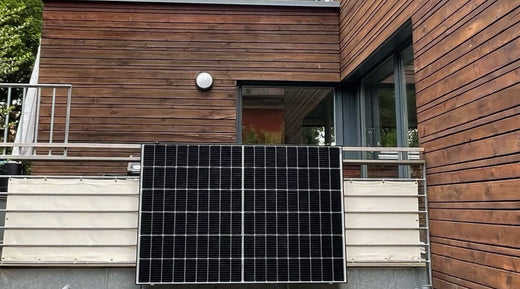
Balcony solar power systems are becoming increasingly popular as a way to reduce electricity costs and produce environmentally friendly solar energy right outside your door. But what is the actual daily yield? How do you calculate the energy yield? What are the performance levels of the different power classes, and how can you get the most out of your mini solar system? This article explains which factors are important for energy generation with such a system and how they influence the yield.
☀️ In short ☀️ A 400W balcony power plant with a 400W inverter generates approximately 2.6 kWh of electricity per day and around 400 kWh per year. A 600W mini PV system with an 800W inverter delivers an average of 3.2 kWh per day and 600 kWh annually.
What is a balcony power plant and how does it work?
Definition and applications of balcony power plants
A balcony power plant is a compact solar system that can be installed on balconies, terraces, or house walls. It generates electricity and gives you a degree of independence. Solar panels convert sunlight into electricity that can be fed directly into your home's electrical grid. This allows users to reduce their electricity costs, consume less power from the grid, and utilize sustainable energy sources.
Who is a balcony power plant suitable for?
Balcony power plants are ideal for renters, homeowners, and city dwellers who live in limited space and are looking for a flexible and cost-effective energy solution to reduce their energy costs. Their use on balconies or balcony railings is particularly well-suited for such a system, as it is easy to install and operate efficiently.

Efficiency and energy savings
How much electricity can a balcony power plant generate per day?
The energy yield varies depending on the model and conditions. A 600-watt balcony power plant can generate approximately 2.88 kWh in summer – enough to power small household appliances such as a laptop or LED lighting for several hours.
Reducing energy costs with a balcony power plant
By feeding electricity into your home's electrical grid, your monthly energy costs will decrease. In the long run, the purchase costs of a balcony power plant will pay for themselves .
Environmental protection and sustainability with balcony power plants
Every kilowatt of electricity generated from solar energy with such a mini solar system reduces CO2 emissions and conserves fossil resources. With a balcony power plant, you make an important contribution to environmental protection.
How is the daily yield calculated?
Calculating the yield of a balcony power plant is based on three main factors: the power output of the modules, the daily solar irradiance, and the system's efficiency. Here's a closer look at the individual steps:
1. Module power (in watts):
The module power indicates how much electricity a solar module can deliver under optimal conditions. For example, a 400-watt module theoretically delivers 400 watts per hour.
2. Daily solar radiation (in hours):
The daily number of hours of sunshine varies depending on the season and geographical location. In summer, you can expect about 6 hours of direct sunlight, while in winter it is often only 2 hours.
3. System efficiency:
Efficiency describes the proportion of solar energy that is actually converted into usable electricity. A typical efficiency of 80% (× 0.8) takes into account losses due to:
- Inverter : The conversion of direct current (DC) to alternating current (AC) causes losses.
- Temperature losses : At high temperatures, the efficiency of solar modules decreases.
- Shading : Small shaded areas can reduce the overall yield.
Example calculation:
A 400-watt module with 6 hours of sunshine and an efficiency of 80% achieves:
400 watts × 6 hours × 0.8 = 1.92 kWh of electricity per day
The same module, with 2 hours of sunshine, would only produce:
400 watts × 2 hours × 0.8 = 0.64 kWh per day
Why is efficiency important?
A realistic efficiency rating helps in planning expected yields and evaluating the system's actual performance. With good modules and optimal orientation, losses can be minimized and yields increased.

Average daily yield by performance class
Comparison of 400w and 600w balcony power plants
400-watt and 600-watt balcony power plants are the most common models. Their daily output depends on solar radiation and operating conditions.
400-watt balcony power plant
-
Sunny summer days : With an average of 6 hours of sunshine, a 400-watt module produces approximately:
400 watts × 6 hours × 0.8 (efficiency) = 1.92 kWh of electricity per day -
Fewer sunny days in winter : With an average of 2 hours of sunshine:
400 watts × 2 hours × 0.8 = 0.64 kWh per day
Balcony power plant 600w
-
Sunny days in summer : With 6 hours of sunshine:
600 watts × 6 hours × 0.8 = 2.88 kWh of electricity per day -
Fewer sunny days in winter : With 2 hours of sunshine:
600 watts × 2 hours × 0.8 = 0.96 kWh per day
Comparison:
A 600W balcony power plant delivers about 1 kWh more per day in summer than a 400-watt module, which means the investment pays off faster.
More powerful with the 800W balcony power plant
800-watt balcony power plants are more powerful and ideal for larger balconies or terraces.
800-watt balcony power plant
-
Sunny days in summer : With 6 hours of sunshine:
800 watts × 6 hours × 0.8 = 3.84 kWh of electricity per day -
Fewer sunny days in winter : With 2 hours of sunshine:
800 watts × 2 hours × 0.8 = 1.28 kWh per day
A notice:
With almost 4 kWh per day in summer, an 800-watt balcony power plant covers the electricity needs of an average fridge-freezer for about two days.
Factors that influence the yield of a balcony power plant
Geographical location and solar radiation
The yield of a balcony solar power plant depends heavily on solar irradiance. In Germany, average solar irradiance varies between 900 and 1200 kWh per year. Southern regions generally achieve higher yields than northern regions.
Weather conditions and seasons
In sunny summer months, the yield is significantly higher than in winter , when the days are shorter and the sun is lower in the sky. Nevertheless, modern balcony power plants can also generate electricity on cloudy days.
Orientation and tilt angle of the modules
The optimal orientation is south-facing, with a tilt angle of approximately 20 to 35 degrees. Deviations in orientation can reduce the yield by up to 20%.

Tips for maximizing daily earnings
Optimal module placement : Ensure that the solar modules are not shaded by trees or neighboring buildings. Regular cleaning of the modules can also significantly increase the yield.
Maintenance and care: How to keep your system efficient. Regularly check the connection to the inverter and monitor the power output. A defective inverter can impair the entire operation.
Utilizing smart energy management solutions: Rely on apps or energy monitoring systems to track yield and optimize usage. Intelligent control makes it possible to consume electricity when it is generated.
Frequently asked questions about balcony power plant yield
How does the yield differ between different models? A 600-watt balcony solar power system achieves higher yields than a 400-watt module, especially on sunny days. However, the choice of model should be tailored to the available space and electricity demand.
Can a balcony power plant supply enough energy for a household? A balcony power plant is generally not sufficient to meet the entire electricity demand of a household, but it can significantly reduce the base load and thus lower the electricity bill.
What role do weather and location play? Locations with plenty of sunshine and optimally oriented modules achieve the best results. Weather conditions such as cloud cover and rain can reduce the yield, but never completely prevent it.


Leave a comment
This site is protected by hCaptcha and the hCaptcha Privacy Policy and Terms of Service apply.