
An inverter is like the heart of a photovoltaic system. This essential device ensures that the direct current (DC) generated by the solar panels is converted into usable alternating current (AC). But what exactly happens during this process? What types of inverters are there, and what should you consider when choosing one? We'll tell you – so you can find the right inverter for your needs!
The inverter – indispensable in photovoltaic systems
The conversion of direct current to alternating current
An inverter, also sometimes called a power inverter, is an essential component of every photovoltaic system. Solar modules generate direct current (DC) , which cannot be used directly in households. Household appliances and the public power grid operate on alternating current (AC) . This is precisely where the inverter comes in: it converts the generated direct current into usable alternating current.
This process is achieved through electronic circuits and transformers that adjust the voltage and frequency of the current. Modern inverters use pulse-width modulation (PWM) to generate a clean sine wave compatible with the power grid. The alternating current plays a crucial role, as it adapts the voltage of the converted current to the grid's requirements. Without this conversion, solar energy would not be usable.
Monitoring and control of the system
Besides conversion, the inverter has a second important task: the optimization and control of the photovoltaic system . Inverters continuously monitor the system's power, voltage, and frequency and adjust the conversion accordingly to ensure maximum efficiency.
Many inverters also perform a safety function. They detect grid disturbances, voltage fluctuations, or defects and can interrupt the feed-in to the grid in an emergency. This protects both the system and the power grid from damage.
What types of inverters are there?
Module inverters (micro-inverters, e.g. from Hoymiles)

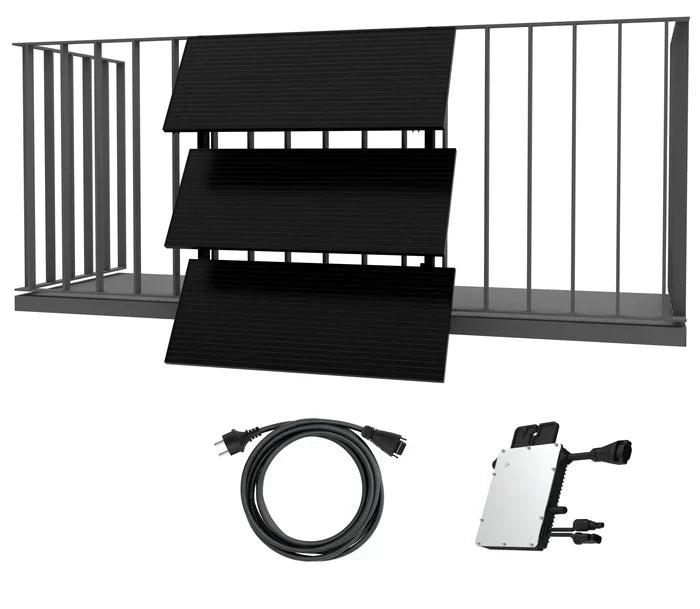
Hoymiles inverters belong to the category of module inverters , also known as micro-inverters . They are neither hybrid nor central nor string inverters , but are specifically designed for decentralized power conversion at the module level.
Module inverters, also called micro-inverters , are connected directly to individual solar modules. This allows each module to operate independently, which is particularly advantageous in photovoltaic systems with partial shading.
A leading manufacturer in this field is Hoymiles , whose inverters for balcony power plants are particularly popular. The advantages:
- Increased efficiency through independent module control. Hoymiles micro-inverters offer an efficiency of up to 96.7%, ensuring that as much solar energy as possible is converted into usable alternating current.
- Easy installation directly on the module
- High safety – Because they operate at low DC voltage, they reduce the risk of electrical hazards.
- Independent power output per module – Each solar module works individually, so that shade on one module does not affect the entire system.
- Plug-and-play installation – No complicated wiring required, ideal for balcony power plants and smaller PV systems.
How does that work with Hoymiles and battery storage?
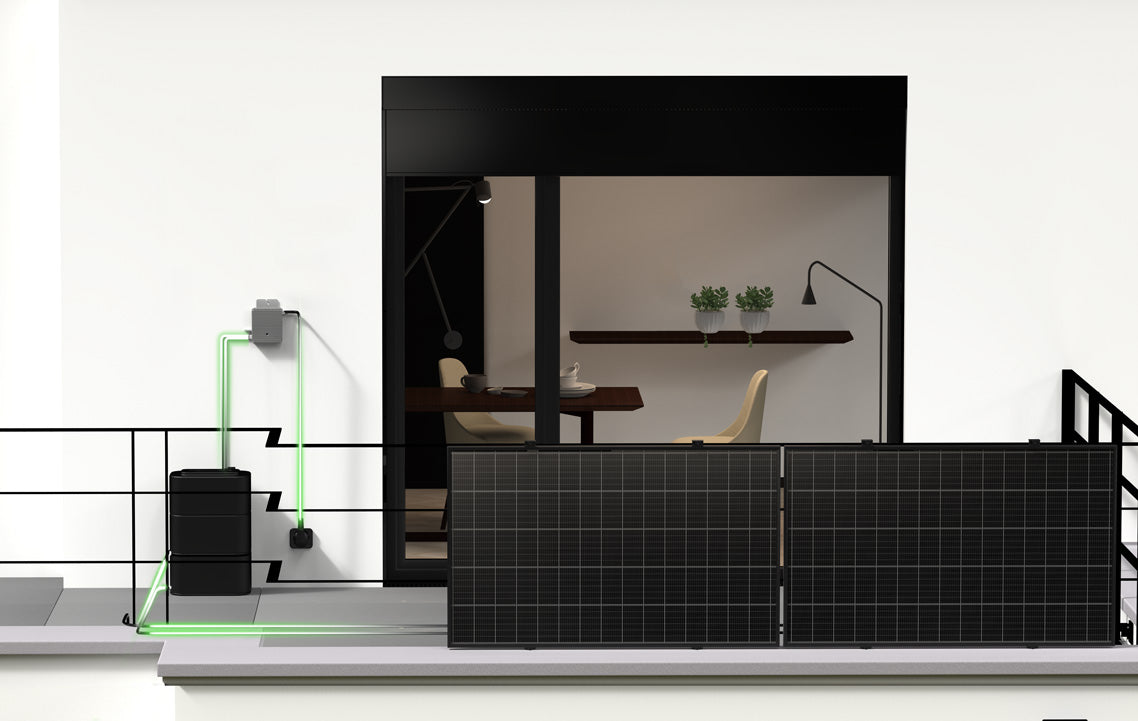
Hoymiles module inverters do not have a direct storage function themselves. They are designed to feed the generated alternating current directly into the grid.
However, you can still store energy using anexternally connected battery storage system .
How exactly does that work?
➡️ The Hoymiles inverter converts the direct current from the solar modules into alternating current.
➡️ The coupled storage unit absorbs the alternating current and stores it for later use.
➡️ When you need electricity, the storage system feeds it back into the house grid.

String inverter (string inverter)
String inverters are used in larger photovoltaic systems where multiple solar modules are connected in series ( strings ). This type of inverter operates centrally for an entire string of modules and offers a cost-effective solution for larger solar installations or ground-mounted systems. One disadvantage is the potential power loss in the event of partial shading , as a weak module can affect the performance of the entire string.
Central inverter
Central inverters are the largest inverters and are used for commercial or industrial solar power systems. They can process several hundred kilowatts to megawatts of power. These inverters are particularly efficient but require extensive safety mechanisms and professional planning and installation. Compared to string inverters, central inverters concentrate the energy from many solar modules and operate at high DC voltage before converting the current to AC voltage.
Hybrid inverter
Hybrid inverters combine PV inverters and battery storage control in a single system. They can not only feed electricity into the grid but also store it in batteries for later use. This significantly increases self-consumption rates but is more expensive than conventional inverters.
But why is a conversion to alternating current even necessary?
Today, the public electricity grid uses alternating current (AC) because it has proven to be the most efficient and practical solution for electricity transmission. However, this wasn't always the case – originally, there was a major debate about whether direct current (DC) or alternating current was the better system.
The decisive advantage of alternating current (AC) lies in its flexibility in voltage adjustment . Transformers allow AC to be easily stepped up to higher voltages, enabling energy to be transmitted over long distances with less loss . This was one of the main weaknesses of direct current (DC) in the past: without transformers, DC grids required the construction of many small power plants near consumers, as high voltages could not be easily changed. In contrast, the use of AC made it possible to build large power plants far from cities, revolutionizing energy supply.
This advantage led to a competition between Nikola Tesla and Thomas Edison at the end of the 19th century, also known as the " War of the Currents ." Edison championed direct current (DC), as he considered this system safer. Tesla, on the other hand, supported by George Westinghouse, developed alternating current (AC) generators and demonstrated that AC could be transmitted far more efficiently over long distances. Ultimately, AC became the standard for public power supply and remains the basis of energy distribution worldwide.
Besides its efficient transmission, alternating current (AC) has another advantage: it can be used directly by most electrical devices . Household appliances, industrial plants, and lighting systems were all designed for AC because the grid is based on it. If the power grid operated with direct current (DC), complex conversion processes would be necessary to make the electricity usable for many applications.
Nevertheless, direct current (DC) is experiencing a comeback today – particularly with high-voltage direct current (HVDC) transmission . Modern technologies now enable the low-loss transmission of DC over extremely long distances, for example, when connecting offshore wind farms to the mainland. DC is also gaining importance in households: solar panels, battery storage systems, and electric cars primarily operate on DC, meaning that alternating current (AC) often has to be converted back into DC. This leads to hybrid inverters and intelligent energy storage solutions playing an increasingly important role in combining the advantages of both types of electricity.
Choosing the right inverter
Pay attention to performance and efficiency
Choosing the right inverter depends heavily on the size and power output of the photovoltaic system. An undersized inverter cannot convert the system's full power, while an oversized inverter operates inefficiently. Important factors include:
- DC input voltage and power
- AC output power
- Efficiency (optimal: over 95%)
Consider compatibility with your PV system.
Not every inverter is compatible with every PV system. It is important that the voltage and power ratings of the solar modules match the inverter's specifications. The number of string inputs can also play a role.
A Hoymiles inverter for your balcony power plant
Hoymiles offers inverters specifically optimized for balcony power plants and small photovoltaic systems . For households seeking a cost-effective and efficient solution , Hoymiles inverters are an excellent choice.
Installation and maintenance of inverters
Optimal placement is important
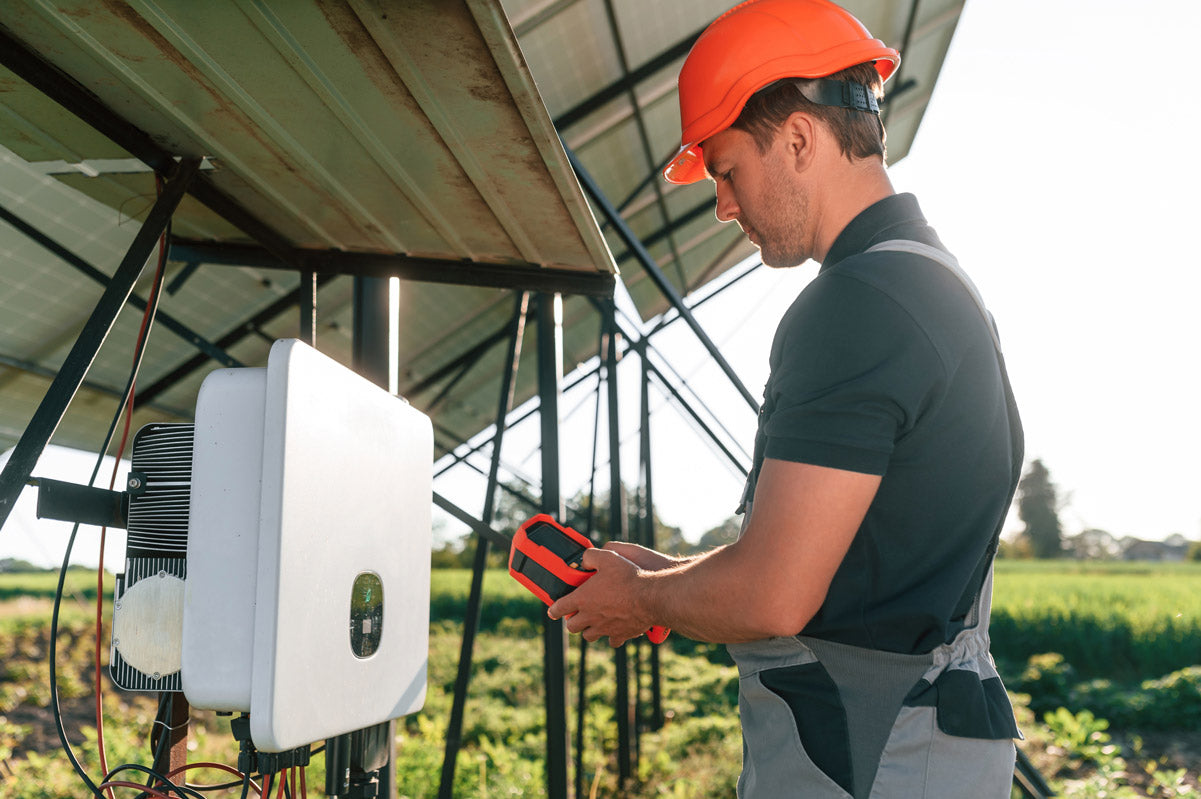
The correct positioning of an inverter affects its lifespan and efficiency . Ideally, it should be installed in a shaded, well-ventilated location to prevent overheating. For module inverters, this is usually directly on the solar panels.
Keep an eye on your inverter – regular maintenance and monitoring
An inverter should be checked regularly to detect potential defects early. Modern devices offer monitoring systems that display performance data in real time. Important maintenance measures include:
- Clean the heat sink (to prevent overheating)
- Check voltage values
- Perform firmware updates
How can I identify a defective inverter?
An inverter is the heart of a photovoltaic system. If it malfunctions, the generated solar power cannot be used effectively. There are several typical signs that can indicate a defect:
- Sudden drop in power output: If the power fed into the grid or the current flow to household appliances drops abruptly, this could indicate a defect. This could be caused by damaged power electronics , overheating, or an internal fault in the inverter.
- Error messages on the display: Modern inverters have displays or app monitoring that report malfunctions. Typical error messages can indicate voltage problems, overheating, or communication errors with the system. Some inverters automatically shut down in these cases to prevent damage.
- No power flow despite sunlight: If the solar panels are generating electricity, but no power is being fed into the household or the grid, this could indicate a defect in the inverter. Possible causes include an incorrect DC input voltage , a blown fuse , or a hardware problem within the inverter itself.
If any of these symptoms occur, it can be helpful to first check the wiring, fuses, and mains connection . If the inverter still does not work, it is recommended to contact a professional or the manufacturer.
Frequently Asked Questions (FAQs)
How long does an inverter last?
The average lifespan of an inverter is 10-15 years . High-quality models, such as those from Hoymiles, can last longer, especially if they are well maintained.
How much does an inverter cost?
The costs vary greatly depending on the type and performance:
- Module inverter (e.g. Hoymiles) : approx. €100 - €300
- String inverters : approx. €500-2,000
- Hybrid inverters : €1,500 and up
How long does it take to install an inverter?
The installation time depends on the type of inverter. Micro-inverters for balcony power plants can be connected in a few minutes, while larger string or central inverters often need to be installed by a specialist company.
Are all inverters approved for grid feed-in?
No, not every inverter is approved for feeding power into the public grid. In Germany, inverters must comply with a VDE standard (e.g., VDE-AR-N 4105) . Especially with balcony power plants, it is important to ensure that the inverter meets the grid and system protection requirements .

Leave a comment
This site is protected by hCaptcha and the hCaptcha Privacy Policy and Terms of Service apply.